The Vitamin A Blind Spot: From Night Vision to Thyroid Function, What Standard Tests Miss
Vitamin A deficiency does not just affect your eyes. It impairs thyroid hormone conversion, degrades spatial memory, and disrupts hippocampal function. And if you carry a common genetic variant, you may be deficient without knowing it, because the standard tests are not looking in the right place.
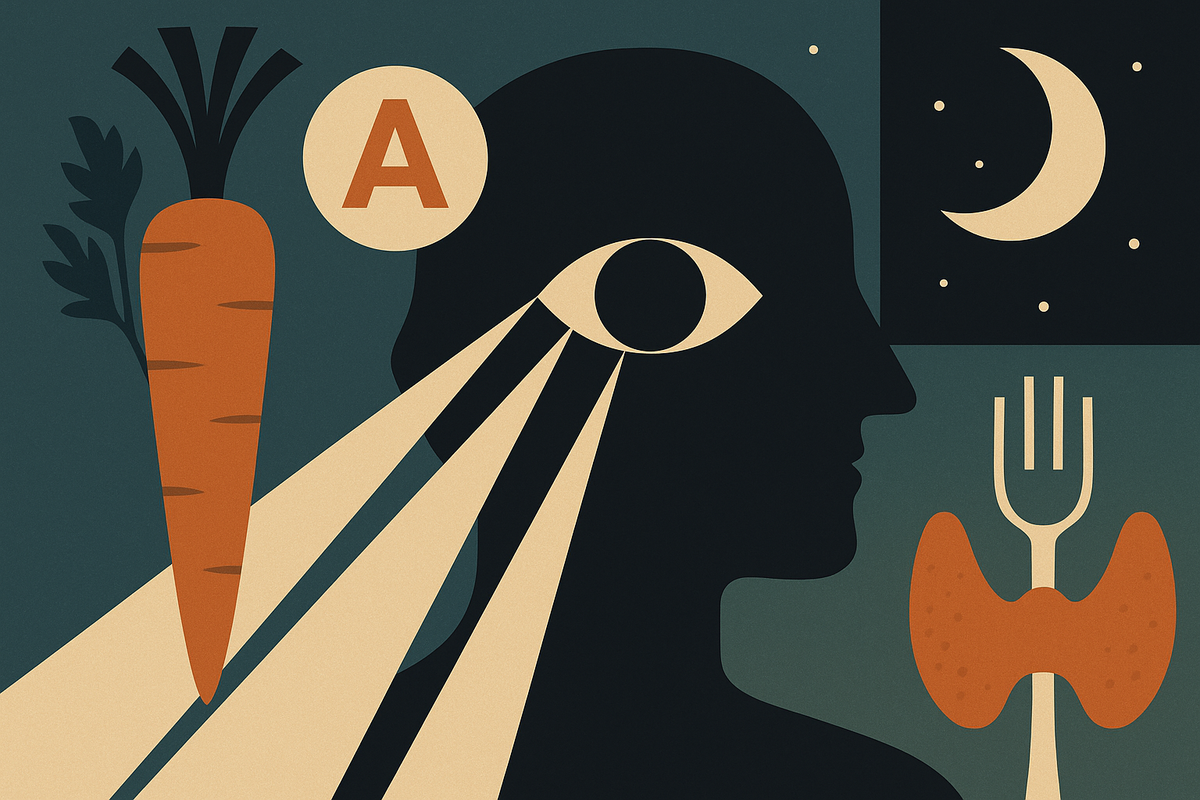
Most people associate vitamin A with eyesight. Eat your carrots, protect your night vision. It is one of those nutritional truisms that has been around long enough to feel settled.
But the more I research vitamin A, the less settled anything about it seems. And in my case, the research became personal when my own lab work, genetic data, and decades of symptoms started connecting in ways I had never considered.
The Symptoms I Never Connected
I have had night blindness since my late teens. Driving at night has always been difficult. Adjusting to dark rooms takes longer than it should. I assumed it was just how my eyes worked.
Around the same time, I started noticing spatial memory and navigation issues. Difficulty orienting in unfamiliar places, a sense that my internal compass was unreliable, the kind of thing you compensate for without questioning it.
Two symptoms, both starting in my late teens, both persistent for decades. I never connected them to each other, let alone to nutrition. Night blindness feels like an eye problem. Spatial memory feels like a brain problem. Why would they share a cause?
Then I saw my RBC vitamin A results. They were low. And when I went looking for what vitamin A deficiency actually does, both of my symptoms were on the list: night blindness as the classic, textbook sign, and spatial memory impairment as the less obvious but equally documented one.
The spatial memory mechanism is specific. Vitamin A (as retinoic acid) is required for long-term potentiation in the hippocampus, the brain region responsible for spatial navigation, memory consolidation, and learning. Without adequate vitamin A, hippocampal neurons lose their capacity for synaptic plasticity. A PNAS study showed that vitamin A deprivation causes "reversible loss of hippocampal long-term synaptic plasticity." A PLOS One paper demonstrated that mid-life vitamin A supplementation can prevent age-related spatial memory deficits by supporting hippocampal neurogenesis.
Reversible. That word mattered to me.
The Genetic Piece That Explained the Deficiency
Once I saw the connection between low RBC vitamin A and my symptoms, I did what any systems thinker would do: I looked upstream. Why was my vitamin A low in the first place?
Vitamin A exists in two dietary forms. Retinol (preformed vitamin A) comes from animal sources: liver, egg yolks, dairy, fish. Beta-carotene (provitamin A) comes from plants: carrots, sweet potatoes, leafy greens. Your body converts beta-carotene to retinol through an enzyme encoded by the BCMO1 gene (also called BCO1).
I ran my genetic data through a SNP analysis. I carry variants in my BCMO1 gene.
This is not rare. Common genetic variants in BCMO1 dramatically reduce beta-carotene conversion, and up to 45% of the population may be low responders to dietary beta-carotene:
- rs12934922 (R267S) and rs7501331 (A379V): People carrying the T allele on both show a 69% decreased conversion of beta-carotene to retinol
- rs6420424, rs11645428, and rs6564851: These upstream variants reduce BCMO1 catalytic activity by 48-59%
A 69% reduction in conversion means that someone eating what should be an adequate plant-based diet for vitamin A could be functionally deficient. Their serum beta-carotene might even look high (because it is accumulating unconverted), while their actual retinol status is low.
For me, this reframed decades of dietary assumptions. All those carrots and sweet potatoes were not doing what I thought they were doing. My body needed preformed retinol, and it was not getting enough.
The Thyroid Connection
This is the part that surprised me most, and the part your doctor is unlikely to mention.
Vitamin A is directly required for the conversion of T4 (the inactive thyroid hormone) to T3 (the active form your cells use). The mechanism involves a transport protein called transthyretin (TTR), which binds to both vitamin A and T4. When vitamin A is adequate, TTR facilitates the conversion process. When vitamin A is deficient, TTR binds T4 but the conversion to T3 is impaired.
The implications are significant:
- You can have normal TSH and normal T4 on standard thyroid panels, but reduced T3 because the conversion is failing
- Vitamin A deficiency damages the formation of thyroglobulin, a protein precursor to thyroid hormones
- Studies show that vitamin A supplementation in deficient patients increased T3, T4, free T3, and free T4 levels
- Vitamin A deficiency may increase the risk of developing Hashimoto's thyroiditis (autoimmune thyroid disease)
- 80% of T4 to T3 conversion happens in the liver, and vitamin A is also critical for liver function
This is where my own data adds another layer. I have a history of reverse T3 (rT3) abnormalities. When T4 is not converting efficiently to active T3, there are two things that can happen: the T4 can sit unconverted, or it can be shunted down an alternative pathway to reverse T3 (the inactive form). High rT3 is typically driven by stress, inflammation, cortisol, and liver dysfunction. But the vitamin A piece adds a third possibility: the conversion cofactor itself is missing.
In practice, the distinction matters for testing:
- High rT3 + low T3 = likely a stress/inflammation/liver problem redirecting conversion
- Normal rT3 + low T3 + normal T4 = could point to a conversion cofactor problem (vitamin A, selenium, zinc, iron)
- The T3/rT3 ratio tells you the net conversion efficiency regardless of the cause
In my case, the rT3 abnormality, the low RBC vitamin A, and the BCMO1 variants all point in the same direction. The thyroid was never the problem. The conversion infrastructure was.
What I Am Doing About It
Once the genetic picture became clear, the intervention was straightforward: bypass the broken conversion pathway entirely. Instead of relying on beta-carotene from plants, I take preformed retinol from animal sources.
Specifically, I alternate between cod liver oil and desiccated beef liver tablets. The choice of these two is not random. I have three confirmed deficiencies (vitamin A, vitamin D, and copper, which I wrote about in a previous post), and these two supplements address all three through a single, coherent approach.
Cod liver oil provides preformed vitamin A (retinol) alongside vitamin D and omega-3 fatty acids, all in a fat-soluble platform that supports absorption. I am also vitamin D deficient due to VDR gene variants (a topic for a future post), so the combination of A and D in one source is particularly efficient.
Desiccated beef liver provides preformed vitamin A, vitamin D, a broad B-vitamin profile, and copper. That last one matters. As I explored in my copper article, intracellular copper deficiency impairs mitochondrial energy production, connective tissue maintenance, and neurotransmitter synthesis. Beef liver is one of the richest natural sources of bioavailable copper.
Three deficiencies, two supplements, zero reliance on the broken conversion pathways that created the deficiencies in the first place. That is the kind of solution a systems thinker looks for: address the root cause, not the individual symptoms.
I am not megadosing. Vitamin A is one of the few vitamins where toxicity from oversupplementation is a real concern. Preformed retinol is fat-soluble and accumulates. The approach is to provide what my body cannot efficiently produce from plant sources, monitored through periodic RBC testing, not to flood the system.
Why Standard Blood Tests Miss This
This connects to something I wrote about in my copper article: the difference between what is in your blood and what is in your cells.
A standard serum vitamin A (retinol) test measures what is circulating in your bloodstream. The body tightly regulates serum retinol, pulling from liver stores to maintain blood levels. This means your serum retinol can look normal even when your liver stores are significantly depleted. By the time serum retinol drops below the reference range, the deficiency is already severe.
More informative approaches include:
- RBC (red blood cell) testing: Measures what is actually inside your cells, not just floating in your blood. This is how my deficiency was caught.
- Retinol binding protein (RBP): Reflects vitamin A transport capacity
- BCMO1 genotyping: If you carry the low-converter variants, your approach to vitamin A intake changes fundamentally. You need preformed retinol, not beta-carotene.
- Comprehensive thyroid panel: Free T3, reverse T3, and the T3/rT3 ratio tell you whether conversion is actually happening, regardless of what TSH and T4 show
The pattern I keep seeing in my research is the same: standard tests measure what is easy to measure (serum levels, total counts, single markers), not what actually reflects the functional state of the system. The signal is in the intracellular data, the conversion ratios, the genetic context. The standard tests often show you the noise.
How This Connects to Everything Else
For anyone who has been reading my previous posts on brain fog and the copper paradox, the vitamin A story adds another layer to the same pattern.
The brain fog cascade I described (trauma destabilizes the nervous system, antibiotics destroy the gut, inflammation becomes self-reinforcing, mitochondria degrade, the brain throttles itself) has a nutrient deficiency layer underneath it. If the gut was damaged early in life, fat-soluble vitamin absorption (A, D, E, K) would have been impaired for decades. Layer a BCMO1 genetic variant on top of that, and the vitamin A deficit compounds further. The deficiency then:
- Impairs hippocampal neurogenesis and spatial memory (compounding the cognitive effects of the cascade)
- Blocks T4 to T3 conversion (explaining thyroid symptoms that do not show up on standard panels)
- Weakens immune function (making someone more susceptible to infections, which drive more inflammation)
- Reduces the body's capacity to maintain mucosal barriers in the gut (worsening the gut permeability that started the problem)
It is not one deficiency causing one symptom. It is a deficiency that touches multiple systems simultaneously, each of which was already under stress from other causes.
What Gives Me Pause
The BCMO1 data is solid. The thyroid connection is published in peer-reviewed journals. The hippocampal research is well-replicated in animal models. And my own lab work, genetics, and symptom history align with the published mechanisms.
But I have the usual caveats:
The spatial memory research is primarily in rats. The human data on vitamin A and cognition is less extensive, though the biochemistry (retinoic acid receptors in the hippocampus) is well-established in humans. I cannot prove that my navigational difficulties since my teens were caused by vitamin A deficiency. I can only observe that the deficiency was present, the genetic predisposition was confirmed, and the mechanism is documented.
The thyroid connection, while mechanistically clear, is not routinely tested for or treated in clinical practice. My rT3 abnormality could have multiple contributing causes. Attributing it primarily to vitamin A is my interpretation, not a clinical diagnosis.
And the "reversible" finding from the hippocampal research is encouraging, but the studies involved controlled vitamin A repletion in animal models. Whether decades of suboptimal vitamin A in a human can be meaningfully reversed by supplementation is a question I am answering in real time, not one the literature has definitively addressed.
Where I Stand
This is one of the clearest examples I have found of a single nutrient deficiency creating a web of downstream consequences that get attributed to separate, unrelated conditions. Night blindness, spatial memory issues, thyroid dysfunction, immune weakness, gut permeability: five problems that a doctor would likely treat as five separate issues, potentially missing the common upstream cause.
The broader lesson is the same one that keeps emerging across these articles: a single nutrient deficiency is rarely just about that nutrient. It is about the systems that nutrient supports, the conversion pathways it enables, and the downstream failures that accumulate when it is missing. The standard tests measure the surface. The signal is deeper.
This is Signal & Noise: the BCMO1 genetics are confirmed in my own data, the thyroid mechanism is published, the hippocampal research is replicated. The causal chain connecting all of these in my specific case is my interpretation, grounded in evidence but not clinically proven. That honesty is the point.
The content on this site reflects personal experience and personal research. Nothing here constitutes medical advice or professional recommendations. For the full disclaimer, see the About page.