The Copper Paradox: Deficient and Toxic at the Same Time
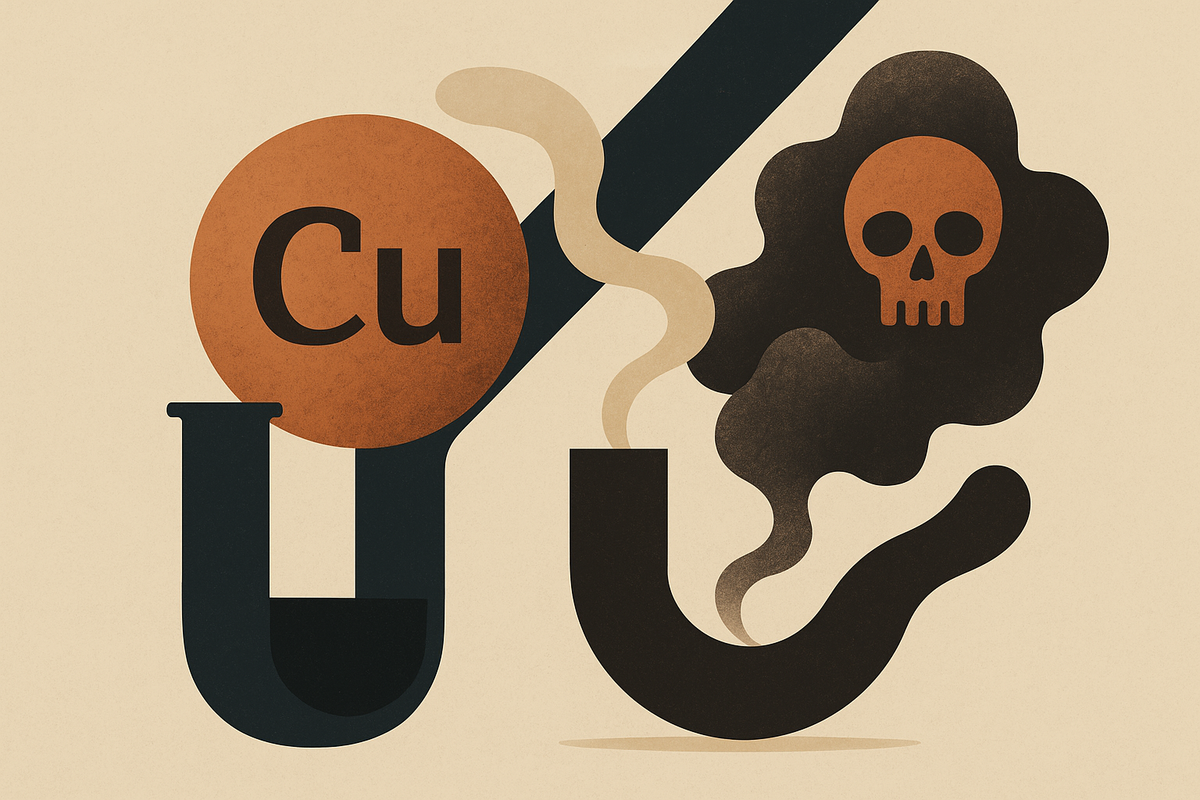
Medical tests say copper toxicity is an epidemic. But the real story may be the opposite: your cells are starving for copper while excess copper floats outside them, unbound and destructive. The problem is not too much copper. It is copper in the wrong place, in the wrong form.
I have been researching copper for a while now, mostly because my own lab work keeps pointing to a deficiency. Low RBC copper. Low WBC copper. The kind of results that make the picture seem straightforward: I need more copper.
But the more I researched, the more I encountered a claim that seemed to contradict everything: that we are in the middle of a copper toxicity epidemic. That excess copper is driving Alzheimer's, cardiovascular disease, arthritis, and a list of other conditions. That people have too much copper, not too little.
Both of these things appeared to be true at the same time. And once I understood why, the entire picture of copper in the body changed for me.
The Paradox
Here is the core insight that most discussions about copper miss: copper deficiency and copper toxicity can exist simultaneously in the same person. They are not opposite ends of a spectrum. They are two symptoms of the same underlying failure.
The failure is not in how much copper you consume. It is in how your body handles it.
Copper in the body exists in two states: bound and unbound. When everything works correctly, 85-95% of copper in the blood is bound to a protein called ceruloplasmin, which transports it safely to the cells that need it. The remaining copper is loosely bound to albumin and small molecules.
When ceruloplasmin function is impaired, or when the system that loads copper into ceruloplasmin breaks down, something troubling happens: copper accumulates in the blood and extracellular space in its unbound form, while cells become starved for the copper they need to function.
Unbound copper is not inert. It is a powerful free radical. It catalyzes the formation of reactive oxygen species, drives oxidative stress, destroys cell membranes, and damages tissues. This is the copper toxicity that the medical literature warns about.
But the cells themselves, the ones doing the actual work of keeping you alive, are copper-deficient. They cannot access the copper floating around outside them because it is not in a form they can use.
This is not theoretical. A 2025 paper in Frontiers in Neuroscience documented exactly this pattern in Alzheimer's disease: intracellular copper depletion alongside extracellular copper accumulation. In diabetic cardiomyopathy, researchers found 2-3 times higher extracellular copper levels in heart tissue while intracellular copper was depleted. The copper was there. The cells could not use it.
Copper 1 vs. Copper 2: The Form Problem
This leads to the second part of the puzzle: not all copper is the same.
Copper exists in two oxidation states:
- Cu1+ (cuprous, reduced): This is the form your cells actually need. It is the active form required for mitochondrial energy enzymes, particularly cytochrome c oxidase, which is essential for ATP production.
- Cu2+ (cupric, oxidized): This is the form found in most supplements, most foods, and most soil. It is the oxidized form that needs to be converted to Cu1+ before your cells can use it.
The conversion from Cu2+ to Cu1+ requires biological machinery that does not always work efficiently. People with digestive issues, chronic illness, high oxidative stress, or impaired liver function may struggle to make this conversion. They consume copper, their blood copper levels look normal or even high, but their cells remain functionally deficient because the copper never gets reduced to the usable form.
This is where the "copper toxicity epidemic" narrative breaks down. What many practitioners are measuring as copper excess is actually unbound Cu2+ floating in the blood because the body cannot process it into the Cu1+ form that cells need. The solution is not to restrict copper further. That makes the intracellular deficiency worse. The solution is to understand why the conversion is failing.
The Soil Problem
Layer the agricultural angle on top of this, and the picture gets worse.
In the 1930s, people consumed between 4 to 6 milligrams of copper daily from natural diets. By the 1960s, intake had dropped to 2 to 5 milligrams. Today, the RDA for copper is 0.9 milligrams, a fraction of what previous generations consumed.
Part of the reason is soil depletion. Approximately 80% of copper in agricultural soil exists as insoluble compounds (oxides and sulfides) that plants cannot utilize. Only about 20% is in a soluble form available to plants. As soils have been depleted through decades of industrial agriculture without adequate mineral replenishment, the copper content of the food grown in them has declined.
But there is a deeper issue. Plants primarily take up copper as Cu2+ (the oxidized form). The bioavailable Cu1+ form is less prevalent in depleted soils. So even when copper is present in food, it arrives in your body in the form that requires conversion, a conversion that may already be compromised.
The result: less copper in the diet than our grandparents consumed, and what little copper we do get arrives in a form our bodies struggle to use. Meanwhile, any copper that does enter the bloodstream but fails the conversion accumulates as unbound Cu2+, showing up on lab work as apparent copper excess.
What Copper Deficiency Actually Does
The downstream effects of intracellular copper deficiency are significant, and they connect to conditions that are often attributed to other causes.
Iron dysregulation. This is perhaps the most dangerous consequence. Copper is essential for the enzyme ceruloplasmin, which is also responsible for safely oxidizing iron for transport. Without adequate copper, iron cannot be properly managed. It accumulates in tissues, causing oxidative damage (what one source in my vault calls "rusting out of the organs"), while simultaneously causing anemia because iron cannot be effectively loaded into hemoglobin. You can be iron-toxic and anemic at the same time, for the same reason you can be copper-toxic and copper-deficient at the same time.
Mitochondrial dysfunction. Cytochrome c oxidase, the terminal enzyme in the mitochondrial electron transport chain, requires Cu1+ to function. Copper-deficient mitochondria produce less ATP. Less energy means slower repair, impaired detoxification, and the kind of systemic fatigue that overlaps heavily with what people experience as chronic fatigue or brain fog.
Connective tissue breakdown. Copper is required for lysyl oxidase, the enzyme that cross-links collagen and elastin. Copper deficiency contributes to joint problems, vascular weakness, and skin changes. For someone with existing arthritis, this is not a minor detail.
Neurotransmitter disruption. Dopamine synthesis requires copper-dependent enzymes (dopamine beta-hydroxylase). Copper deficiency can impair the conversion of dopamine to norepinephrine, affecting mood, motivation, and cognitive function.
Why Standard Testing Misses This
A standard serum copper test measures total copper in the blood. It does not distinguish between bound copper (safely carried by ceruloplasmin, on its way to cells) and unbound copper (floating free, causing oxidative damage, unavailable to cells).
So a patient with high serum copper gets told they have copper excess. The recommendation: avoid copper, reduce intake. Meanwhile, their intracellular copper is depleted, their mitochondria are struggling, their iron metabolism is disrupted, and their connective tissue is degrading.
The more informative tests would include:
- Ceruloplasmin levels (is the transport protein functioning?)
- Free (unbound) copper calculation (serum copper minus ceruloplasmin-bound copper)
- RBC copper (what is actually inside the cells?)
- Zinc-to-copper ratio (zinc and copper compete for absorption)
My own lab work showing low RBC copper is, in this framework, more revealing than a serum copper test would be. It suggests that regardless of what is floating in my blood, my cells are not getting what they need.
What Gives Me Pause
This narrative is compelling. It connects multiple dots (iron dysregulation, mitochondrial dysfunction, connective tissue problems, brain fog) through a single mechanism. And the peer-reviewed research on the intracellular/extracellular paradox is real, not speculative.
But I have concerns:
The "copper toxicity epidemic" framing comes largely from alternative and functional medicine practitioners, not mainstream medical consensus. That does not make it wrong, but it means the claims have not been through the same level of scrutiny.
The Cu1+ supplement angle is being pushed by companies with financial incentives. The science on cuprous vs. cupric bioavailability in humans is limited. Most of the soil chemistry research is about plant uptake, not human nutrition endpoints.
The Root Cause Protocol and similar frameworks present copper repletion as a solution to a wide range of conditions. When one intervention claims to fix everything, that is usually a signal to slow down and look more carefully at the evidence for each specific claim.
And the ceruloplasmin story, while biochemically sound, raises the question: why is ceruloplasmin function impaired in the first place? Liver disease, chronic inflammation, genetic factors, and nutritional deficiencies (including copper itself, creating a circular problem) all play roles. Supplementing copper without understanding the upstream cause of the ceruloplasmin failure may not solve the problem.
Where I Stand
I came into this research because my own lab work pointed to copper deficiency. What I found was more complex and more interesting than a simple deficiency story.
The simultaneous deficiency-and-toxicity paradox is real. The peer-reviewed research supports it, at least in specific disease contexts like Alzheimer's and diabetic cardiomyopathy. The Cu1+/Cu2+ distinction is biochemically valid. The soil depletion data is concerning. And the standard testing paradigm clearly misses important nuance.
Whether this fully explains my own situation, I do not know yet. But it has changed how I think about copper, and about mineral metabolism more broadly. The lesson is not "take more copper" or "avoid copper." The lesson is that the question "do I have enough copper?" is the wrong question. The right question is: "Is copper getting where it needs to go, in the form my cells can use?"
That is a harder question to answer. And it is exactly the kind of question this site exists to sit with honestly.
This is Signal and Noise. This topic is Signal & Noise: the paradox is supported by published research, the mechanisms are biochemically coherent, but the clinical application and the scope of the claims remain partially unresolved.
The content on this site reflects personal experience and personal research. Nothing here constitutes medical advice or professional recommendations. For the full disclaimer, see the About page.