Breathing as a Systems Intervention: What Actually Changes When You Slow the Breath
Breathing is the only autonomic function you can consciously override. That makes it a direct manual control on a system that otherwise runs without your input.
Of everything I have researched for this site, breathing is the intervention I was most skeptical about and the one that turned out to have the strongest evidence base.
Not breathing as meditation. Not breathing as relaxation. Breathing as a mechanical, measurable, physiological intervention on the autonomic nervous system, with published effects on heart rate variability, cortisol levels, inflammatory markers, blood sugar regulation, and sleep architecture.
The reason it works is also the reason it is easy to dismiss: it seems too simple. You slow your breathing down, make your exhales longer than your inhales, and things change. But the "things that change" turn out to be precisely the systems I have been writing about on this site for weeks. That is not a coincidence.
The One Override You Have
Your autonomic nervous system controls heart rate, digestion, immune response, hormone release, and dozens of other processes without your conscious involvement. You cannot decide to lower your cortisol. You cannot will your vagus nerve to fire. You cannot consciously suppress an inflammatory cytokine.
But you can control your breathing. And breathing is wired directly into the autonomic system in a way that no other voluntary action is.
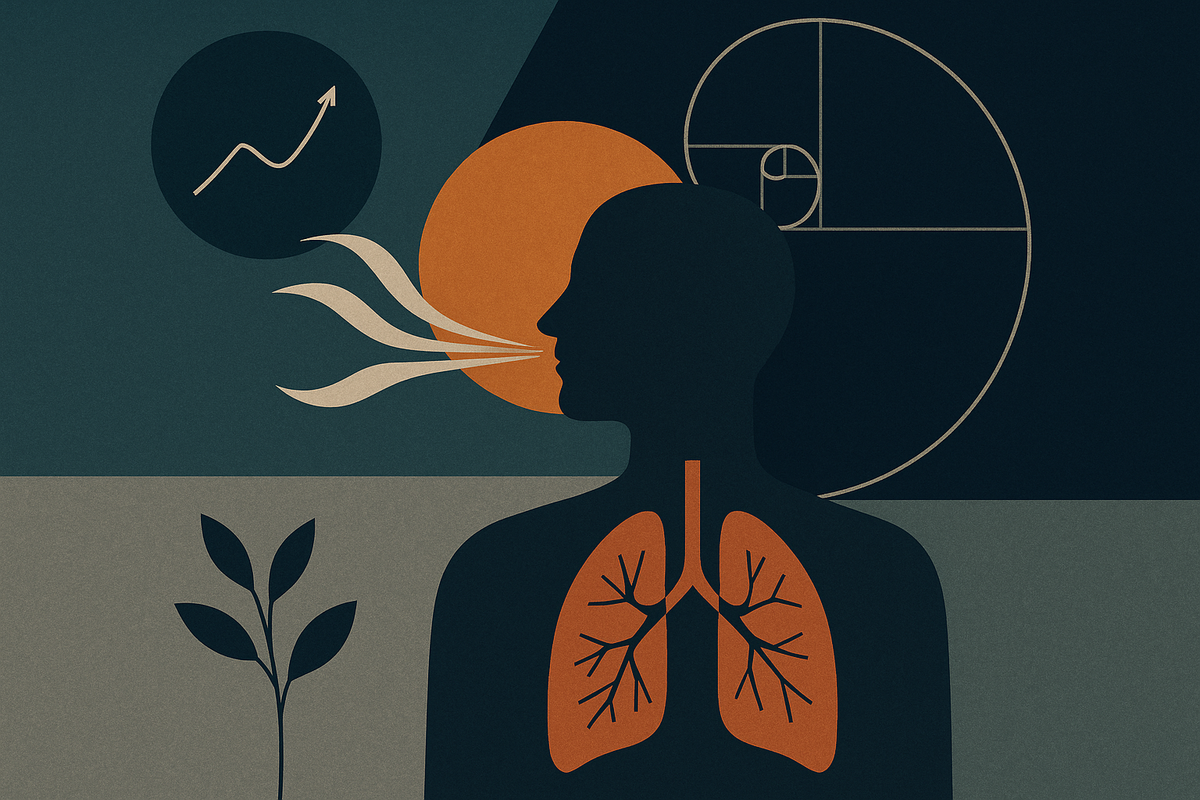
This is not metaphorical. The vagus nerve, the primary conduit of the parasympathetic nervous system, physically passes through the diaphragm. When you breathe deeply using your diaphragm (belly breathing, not chest breathing), the diaphragm mechanically presses against the vagus nerve with each breath cycle. This is direct physical stimulation of the nerve that controls your rest-and-repair system.
During inhalation, the cardiovascular center inhibits vagal outflow, and heart rate speeds up (sympathetic dominance). During exhalation, vagal outflow is restored, and heart rate slows down (parasympathetic dominance). This is why the ratio of inhale to exhale matters: longer exhales mean more time in parasympathetic activation per breath cycle.
This is not a relaxation technique. It is respiratory vagus nerve stimulation. The research community has a name for it: rVNS.
What the Evidence Actually Shows
I went into this expecting vague claims about "feeling calmer." What I found was clinical trial data with specific, measurable outcomes.
Heart rate variability. A systematic review and meta-analysis published in 2022 confirmed that voluntary slow breathing increases vagally-mediated HRV during the breathing session, immediately after one session, and after multi-session interventions. The effect was consistent across all studies reviewed, with significant improvements in the high-frequency band that reflects parasympathetic activity. HRV is not just an abstract metric. It is one of the strongest predictors of autonomic flexibility, stress resilience, and cardiovascular wellness.
Cortisol reduction. A randomized controlled trial with Type 2 diabetes patients found that slow deep breathing significantly reduced salivary cortisol compared to control groups. Separately, Sudarshan Kriya Yoga (a structured breathwork protocol) reduced serum cortisol by more than 50% after a single session in veterans with PTSD, with sustained reductions in regular practitioners. That number, more than half, from one session, caught my attention.
The cyclic sigh. A Stanford study published in Cell Reports Medicine tested three breathing techniques against mindfulness meditation in 111 participants over one month, five minutes per day. The technique that performed best was the "cyclic sigh": a double inhale (one deep breath followed by a second short inhale to fully expand the lungs) followed by a long, slow exhale. The second inhale maximizes oxygen intake and, critically, the extended exhale activates the parasympathetic system. Cyclic sighing produced greater improvement in mood and physiological calm than mindfulness meditation. Five minutes. Per day.
Inflammation. This is where it connects to immunology. The vagus nerve is the primary activator of the cholinergic anti-inflammatory pathway, a mechanism where vagal stimulation triggers acetylcholine release, which suppresses production of pro-inflammatory cytokines (TNF, IL-1B, IL-6, IL-18) by macrophages. Slow breathing with prolonged exhalation activates this pathway. A clinical trial tested slow-paced breathing specifically to stimulate this cholinergic anti-inflammatory reflex in COVID-19 pneumonia patients, targeting IL-6 reduction through vagal activation alone.
Blood sugar. Slow breathing at six breaths per minute improved blood flow, oxygen levels, and nervous system balance in people with diabetes. A separate 12-week study found that diaphragmatic breathing significantly lowered both fasting and post-meal blood sugar in women with Type 2 diabetes. The mechanism: parasympathetic activation reduces sympathetic-driven glucose production by the liver and improves insulin secretion by the pancreas.
Why This Connects to Everything Else
For readers who have been following my previous articles, the breathing research does not introduce a new system. It provides a direct intervention on the systems I have already been describing.
In my brain fog article, I described a cascade: childhood trauma locks the nervous system in sympathetic overdrive, the vagus nerve loses tone, inflammation runs unchecked, the brain throttles itself. The central failure in that cascade is vagal tone collapse. Breathing is the most direct, accessible, daily intervention on vagal tone that exists. It does not fix the cascade. But it applies pressure in the right direction on the exact nerve that is underperforming.
In my sleep article, I described 10 to 30 minutes of deep sleep per night and a nervous system that never fully stands down. Deep sleep requires parasympathetic dominance. If pre-sleep breathing can shift autonomic balance even partially toward parasympathetic, it may extend the window in which deep sleep is possible. The cortisol loop I described (high cortisol blocks deep sleep, poor sleep keeps cortisol high) is the same loop that breathing interventions target.
In my copper and vitamin A articles, I described how cortisol dysregulation impairs thyroid hormone conversion (T4 to T3) and nutrient absorption. Breathing does not fix a copper deficiency or a BCMO1 variant. But reducing cortisol through vagal activation creates a better environment for every other intervention to work in.
The inflammation connection is the most direct. The cholinergic anti-inflammatory pathway that breathing activates is the same pathway I have been writing about as a target for KPV and other peptides. Breathing does it without a needle, without a cost, and without regulatory uncertainty.
The Practical Minimum
The research suggests a surprisingly low threshold for effect:
- Technique: Exhale-dominant breathing. The simplest version is inhale for 3-4 seconds, exhale for 6-8 seconds. The Stanford cyclic sigh (double inhale, long exhale) showed the strongest results in direct comparison.
- Duration: 5 minutes per day produced measurable improvements over one month in the Stanford study. A clinical trial showed effects from 30 minutes twice per week.
- Consistency: A study of over 10,000 participants found that meditation and breathing practice 4-7 days per week predicted reductions in anxiety and sadness. Consistency mattered more than session length.
- Timing: Before sleep may help with the parasympathetic shift needed for deep sleep. During acute stress may interrupt the cortisol cascade in real time.
The barrier to entry is zero. No equipment, no subscription, no injection, no cost. Just a deliberate change in how you breathe for five minutes.
What Gives Me Pause
Honestly, not much. This is one of the better-supported interventions I have encountered in my research.
The HRV and cortisol data are from randomized controlled trials and meta-analyses. The cholinergic anti-inflammatory pathway is established immunology, not fringe science. The Stanford cyclic sighing study was published in Cell Reports Medicine with 111 participants and proper controls.
The caveats are more practical than scientific:
Breathing is easy to describe and surprisingly hard to do consistently. Five minutes a day sounds trivial until you try to maintain it for a month. The compliance challenge is real, and the studies that show sustained benefit all required sustained practice.
The magnitude of effect varies. A 50% cortisol reduction in PTSD veterans from SKY breathing is dramatic. Whether a less structured daily practice in someone without clinical PTSD produces anything close to that is less clear.
And breathing alone will not undo decades of autonomic dysregulation from childhood trauma. It is one lever in a multi-lever system. But it is a lever you can pull every day, for free, starting now.
Where I Stand
I started researching breathing because it kept appearing in my vault alongside vagus nerve content, and I assumed it would be the soft, unmeasurable part of the picture. It turned out to be one of the most measurable interventions I have found, with clinical trial data that meets the same standard I apply to supplements and pharmaceuticals.
For someone whose nervous system has been stuck in sympathetic overdrive for decades, whose deep sleep barely registers, whose inflammation markers are chronically elevated, and whose cortisol rhythm is inverted, this is not a cure. It is a daily practice that applies consistent pressure on the exact systems that are failing. Five minutes of exhale-dominant breathing will not fix my sleep architecture or resolve my brain fog. But it activates the nerve, the pathway, and the autonomic shift that every other intervention I am pursuing depends on.
That makes it foundational. Not dramatic. Not glamorous. But foundational.
This is Signal: the mechanisms are well-characterized, the clinical evidence is strong, and the practical application is testable and repeatable. This is one of the rare topics where the signal is genuinely clear.
The content on this site reflects personal experience and personal research. Nothing here constitutes medical advice or professional recommendations. For the full disclaimer, see the About page.