10 Minutes of Deep Sleep: What Two Years of Data Taught Me About Why I Wake Up Exhausted
I have worn an Apple Watch to bed for two years. My deep sleep averages 10 to 30 minutes per night. The consequences touch everything from brain fog to blood sugar to tissue repair, and the cause may trace back to the same childhood trauma that started the cascade I have been writing about.
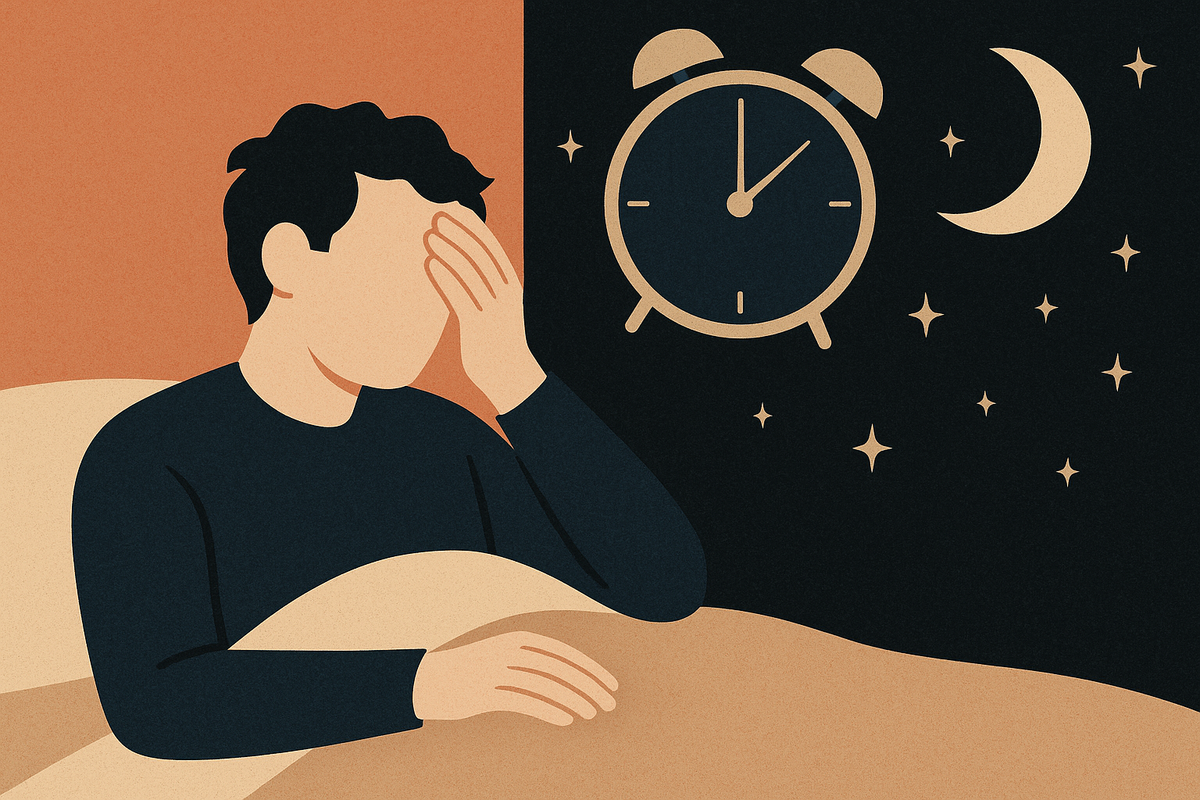
I have known since my early teens that something was wrong with my sleep. Not the falling-asleep part. The waking-up part. Every morning, for as long as I can remember, I wake up feeling unrefreshed. Not groggy in the way that clears with coffee. Unrefreshed in a way that suggests sleep did not do what it was supposed to do.
There is also a quality to my sleep that is harder to describe: a persistent awareness of what is happening around me, as if I am half awake throughout the night. Not fully conscious, but never fully gone either. My body is in bed. My nervous system never fully stands down.
For most of my life, I assumed this was just how I slept. Some people sleep deeply. I do not. I compensated, pushed through, and did not think about it much.
Then I started wearing an Apple Watch Ultra 2 to bed. And two years of data made the problem visible in a way I could no longer ignore.
The Numbers
Over two years of nightly tracking, my sleep data tells a consistent story:
- Deep sleep (slow-wave, N3): 10 to 30 minutes per night
- REM sleep: 50 to 130 minutes per night
- Total sleep: generally adequate in duration
A healthy adult should get 60 to 120 minutes of deep sleep per night, roughly 15-25% of total sleep time. I am getting a fraction of that. On some nights, my deep sleep is in the single digits.
My REM sleep, by contrast, is normal to high. This asymmetry turns out to be significant. It is not random. It is a pattern that the research literature associates with a specific set of causes.
What Deep Sleep Actually Does
Deep sleep (slow-wave sleep, stage N3) is not just "more sleep." It is a biologically distinct state where specific processes happen that cannot happen during lighter sleep stages or REM:
Growth hormone release. Approximately 75% of the body's daily growth hormone is released during deep slow-wave sleep. HGH drives tissue repair, muscle recovery, bone maintenance, and fat metabolism. By age 35, deep sleep typically drops from about 20% to less than 5% of total sleep time, and GH secretion declines by roughly 75% in parallel. My deep sleep numbers at any age have apparently been far below even these declining norms.
Glymphatic brain cleaning. During deep sleep, the spaces between brain cells expand by approximately 60%, allowing cerebrospinal fluid to flow through and flush metabolic waste, including beta-amyloid and tau proteins associated with Alzheimer's disease. Brain waste clearance during sleep is roughly double what it is during waking. This system works best, and possibly only, during deep slow-wave sleep.
Immune maintenance. The immune system performs critical repair and surveillance work during deep sleep. Inflammatory markers rise with sleep deprivation, and even one night of partial sleep loss increases insulin resistance.
Memory consolidation. While REM sleep is associated with emotional and procedural memory, deep sleep is where declarative memory consolidation occurs, the transfer of information from short-term to long-term storage.
When deep sleep is absent or severely reduced, none of these processes complete properly. The body does not repair. The brain does not clean itself. Growth hormone is not released. The immune system falls behind. And the person wakes up feeling exactly the way I have felt every morning for decades: unrefreshed.
Why My REM Is Normal and My Deep Sleep Is Not
This asymmetry is not a coincidence. It maps directly to what the research shows about PTSD and sleep architecture.
In people with PTSD, REM sleep is often the most affected stage, but not in the way you might expect. REM is frequently preserved in duration but fragmented in quality: delayed onset, weaker rhythmicity, and disrupted fear memory processing. During REM, neurotransmitter levels that should drop (allowing the brain to process and file emotional memories) stay elevated. The result is that the brain keeps replaying threat-related content without resolving it.
Deep sleep, meanwhile, can be severely reduced. Some PTSD studies report near-absence of N3 (deep sleep) in affected patients. The mechanism is straightforward: the autonomic nervous system is locked in sympathetic overdrive (fight-or-flight), and deep sleep requires parasympathetic dominance (rest-and-repair). If the vagus nerve is not signaling safety, the body will not let itself become that vulnerable.
This connects directly to what I wrote about in my brain fog article. The childhood trauma that dysregulated my nervous system did not just affect my waking life. It rewired my sleep architecture. The "half awake" quality I have experienced since my teens is not poor sleep hygiene. It is hypervigilance. A nervous system that was programmed by trauma to never fully stand down.
The Feedback Loops
What makes this particularly difficult to address is that insufficient deep sleep creates multiple self-reinforcing loops:
The cortisol loop. High cortisol prevents the body from entering deep sleep. Without deep sleep, cortisol regulation does not reset properly. Cortisol stays elevated. The next night, deep sleep is harder to achieve. The pattern compounds.
The blood sugar loop. During the night, blood sugar can drop too low. The body perceives this as a survival threat and releases cortisol and adrenaline to mobilize stored glucose. This causes awakening, often between 2 and 4 AM, with a racing heart, anxiety, or a sudden sense of alertness. The person falls back asleep eventually, but the deep sleep window is lost. Chronic sleep disruption then increases insulin resistance during the day, which destabilizes blood sugar further, which makes nighttime drops more likely.
The HGH loop. Growth hormone is released during deep sleep. GH deficiency leads to increased visceral fat, decreased muscle mass, reduced cognitive function, and, critically, decreased deep sleep itself. Less deep sleep means less HGH, which means even less deep sleep. The decline that normally happens gradually with aging is accelerated when deep sleep was never adequate to begin with.
The inflammation loop. Sleep deprivation increases inflammatory markers (IL-6, TNF-alpha). Inflammation impairs sleep quality. Poor sleep increases inflammation. This is the same self-reinforcing inflammatory cycle I described in the brain fog cascade, now showing up through a different lens.
The brain cleaning loop. Without adequate deep sleep, the glymphatic system cannot clear metabolic waste from the brain. Waste accumulation impairs neural function, which can further disrupt sleep architecture. Over decades, this is associated with increased risk of neurodegeneration.
Five feedback loops, all reinforcing each other, all stemming from the same root cause: a nervous system that cannot achieve the parasympathetic state required for deep sleep.
The Connection to Everything Else
For readers who have been following my previous articles, this piece connects to nearly all of them:
- Brain fog: The "throttling" I described, the brain slowing itself to prevent damage, is compounded by a brain that never gets cleaned overnight. The glymphatic failure and the excitotoxicity from inflammation are happening simultaneously.
- The copper paradox: Copper-dependent mitochondrial enzymes need adequate cellular energy, which depends partly on the tissue repair that happens during deep sleep. Chronic deep sleep deficit means chronic repair deficit.
- Vitamin A and thyroid: Thyroid hormone conversion (T4 to T3) is influenced by cortisol levels and liver function, both of which are degraded by chronic sleep disruption. The rT3 abnormality I described may be partly driven by the cortisol dysregulation from decades of inadequate deep sleep.
- The trauma cascade: This is arguably the most direct manifestation of the original trauma. The nervous system remodeling that happened in childhood shows up every single night in my sleep data, measurable, persistent, and still active decades later.
What Gives Me Pause
The mechanisms are well-documented. The PTSD-sleep architecture research is published in major journals. The glymphatic system, HGH-sleep connection, and cortisol-blood sugar loops are established science. My Apple Watch data is consistent and spans two years.
But I have the usual caveats:
Consumer wearables measure sleep stages through accelerometer and heart rate data, not polysomnography. The absolute numbers (10 minutes vs. 15 minutes of deep sleep) may not be clinically precise. The trend and the relative proportions are more reliable than the exact figures.
Attributing my sleep architecture primarily to childhood trauma is my interpretation based on the timing (symptoms since my teens), the pattern (preserved REM, absent deep sleep, hypervigilance), and the published research on PTSD sleep disruption. A formal sleep study and clinical assessment would be needed to confirm this.
And the feedback loops, while each individually well-supported, form a system that is difficult to intervene in precisely because everything affects everything else. Fixing cortisol does not automatically fix deep sleep. Fixing blood sugar does not automatically restore HGH release. The question of where to intervene most effectively in a multi-loop system is genuinely complex.
Where I Stand
Two years of data on my wrist have made something visible that I felt but could not quantify for decades. My body sleeps. My nervous system does not rest. The deep sleep that should be repairing tissue, clearing the brain, releasing growth hormone, and resetting cortisol is barely happening.
This is not insomnia. I fall asleep. I stay in bed for adequate hours. The duration looks fine. The architecture is broken. And the consequences of that broken architecture touch every system I have been writing about on this site.
The sleep data is, in some ways, the most direct evidence I have that the trauma cascade from childhood is not just a theory about what happened decades ago. It is a measurable, ongoing, nightly event. My watch records it every morning. The fog I wake up with is not a mystery. It is the predictable result of a brain that never got cleaned and a body that never got repaired.
Understanding this has not fixed it. But it has changed how I think about every other intervention I am pursuing. Whatever I do for copper, vitamin A, inflammation, or vagal tone, it will work better if my body can actually use the night to do what it is supposed to do. Deep sleep may be the bottleneck underneath all the other bottlenecks.
This is Signal & Noise: the sleep architecture research is well-established, the PTSD connection is published, and two years of wearable data confirm the pattern. The causal attribution to childhood trauma and the interactions between the feedback loops remain my interpretation. The data is clear. The path forward is not.
The content on this site reflects personal experience and personal research. Nothing here constitutes medical advice or professional recommendations. For the full disclaimer, see the About page.